The CEB brings together the Secretary-General and the executive heads of 30 UN system organisations as the principal forum for system-wide leadership, coherence and coordination across policy, programme and management. Through its High-Level Committee on Management (HLCM), it advances systemic transformation through, among other things, stronger performance and results orientation; better data, analysis and communications; and innovation and digital transformation.
The CEB Secretariat publishes annual UN system-wide financial and human resources (HR) data. Crucial to this endeavour are the UN Data Standards for UN system-wide reporting of financial data, which aim to improve the quality of such data reported to the CEB.89 Ultimately, having timely, reliable, verifiable, comparable and SDG-aligned financial data – at both a system-wide and entity level – will allow the UN system to ‘make better decisions and deliver stronger support to those we serve’.
CEB member organisations
Source: Source: Chief Executives Board for Coordination (CEB).
3.1 The strategic direction for UN system-wide financial data
In 2021, the HLCM’s Finance and Budget Network (FBN) approved a UN Data Cube Strategy for 2022–2026. Since then, the strategy has sought to provide UN stakeholders with a transparent, comprehensive snapshot of UN system-wide revenue and expenses, enabling better analytics and evidence-based decisions.90
The CEB Secretariat, together with UN system organis-ations, is currently considering the strategic direction of UN system-wide financial data. This work draws on HLCM and FBN reflections concerning the unprecedented financial pressures, ongoing demands for reform and growing chal-len ges to multilateralism facing the UN system. Given present uncertainties around the organisation’s financial outlook and recent actions taken in response to liquidity concerns, calls have been made for more up-to-date financial data.
The FBN responded to these calls by conducting a survey in the first quarter of 2026 aimed at collecting high-level UN system revenue and expense projections for 2026–2027. The findings suggest that the forthcoming period will be marked by tightened funding; increased uncertainty; and growing pressure on entities to reconcile ambitious mandates with constrained, volatile funding.
Total UN system revenue in 2024 was US$ 68.3 billion. This is projected to decline by approximately 21% to US$ 54.3 billion in 2027, with the scale of decline varying by funding source. Entities reliant on voluntary contributions, particularly those with large humanitarian and development portfolios, face acute pressures. By contrast, it is anticipated that entities funded primarily through assessed contributions or service fees will have more stable revenue trajectories.
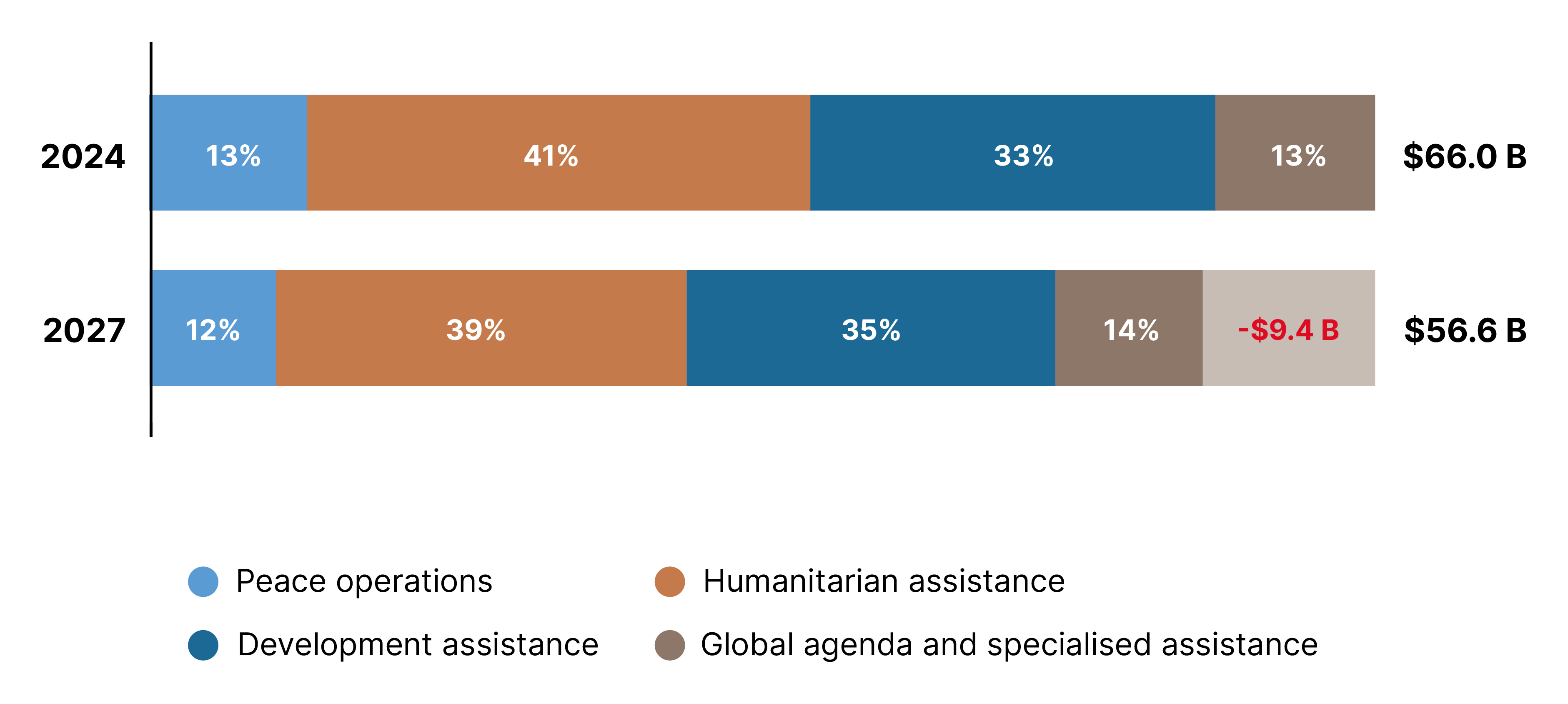
The drop in revenue is reflected by projected UN system expenses for the period, which are expected to fall from US$ 66.0 billion in 2024 to US$ 56.6 billion by 2027. In line with this, many UN organisations anticipate steady reductions in expenses from 2024 to 2027. Not all entities were able to project expenditure by function, meaning these figures should be treated as conservative estimates of the overall scale of adjustment.91
Expense projections for 2025–2027, disaggregated by functional area, indicate that peace operations and humani-tarian assistance will experience some of the sharpest reductions.92 Development assistance and global agenda and specialised assistance, meanwhile, display a more gradual adjustment profile. As can be seen in Figure 42, the projected expenses for 2027 reflect asymmetric cuts, with development assistance actually increasing its share of total expenses compared to 2024. This is in contrast to humanitarian and peace operations, which are set to contract in both absolute and relative terms.
Composition of total expenses
Source: Source: Chief Executives Board for Coordination (CEB).
3.2 Perspectives on the future of UN system-wide financial data
During the first quarter of 2026, the CEB Secretariat consulted chief financial officers across the UN system in order to identify the most pressing financial management challenges and their priority areas for action. The perspectives gathered are informing strategic thinking on UN system-wide financial data. Despite the varying business models, mandates and organisational sizes, several common themes emerged. Particularly prominent were: liquidity and funding challenges; concerns about the impact of workforce cuts; growing demands for oversight and transparency; and the need for digital transformation.
Organisations described an environment beset by uncertainty, affecting both voluntary contributions and the payment of assessed contributions. At the same time, increased earmarking of voluntary funding has restricted financial flexibility. Organisations operating on zero nominal growth budget frameworks have seen their purchasing power eroded as inflation rises, while those grappling with steep reductions describe operating in ‘survival mode’, their operational stability already impacted by cost-containment measures. A number of entities cited escalating challenges due to verification, audit and access-to-information conditions being imposed on funding agreements.
Several areas of prioritisation emerged across entities. Many are focused on strengthening financial resilience, whether through reviewing working capital arrangements, improving liquidity forecasting and/or protecting critical enabling functions. A number of organisations are reassessing their operating frameworks in order to better reflect the digital era and enable exploration of innovative financing and potential private sector engagement. Accelerated digital transformation was a recurring priority, as was the growing need for harmonised approaches to efficiency reporting.
These perspectives paint a clear picture of a UN system that is not only navigating profound financial uncertainty, but having to deal with growing technical and compliance demands, as well as the pressing need for more data. The next phase of the Data Cube Strategy must take account of this financial context while balancing the needs of multiple stakeholders, including reporting entities, data users and partners.
3.3 The CEB Secretariat’s data vision
The CEB Secretariat has continued to enhance the CEB website as the central access point for Member States and other users seeking high-quality UN system-wide financial data. Going forward, all UN system- wide financial data must take account of the CEB Secretariat’s vision for a unified, transparent and intelligence-driven data ecosystem. As part of this, efforts will be made to integrate HR, financial and other data within a coherent, inter-operable framework. Strengthening data governance, deepening data disaggregation and enhancing system-wide accessibility will not only drive evidence-based decision-making but foster accountability, enabling a more agile, efficient and equitable UN system.
In 2026–2027, the CEB Secretariat will take structured, consultative steps to translate its data vision into a practical transformation plan. Subject to resource availability, the CEB Secretariat will build a modern, user-friendly platform that brings together selected UN system operational datasets, starting with HR and financial data. By improving the transparency, coherence and accessibility of UN system information, the platform will offer an invaluable tool for reducing fragmentation, supporting evidence-based decision-making and promoting accountability.
While transparency of operational data is an important element in restoring trust in the UN system, simply making data more easily available is not sufficient in itself. As such, it is important to cultivate benchmarking, as well as a shift away from data-focused reporting to an insights-focused approach.
More specifically, the CEB Secretariat will consider the following areas of action with respect to financial data:
- A more automated end-to-end pipeline from data sub-mission to publication.
- A publication model that improves timeliness, including complementary current-year data streams where feasible.
- Better usability for stakeholders through more navigable products, better structured downloads and reduced reliance on ad hoc requests.
- Expanded financial content, including forward-looking projections where feasible.
- Stronger interoperability with HR and procurement data, enabling priority cross-domain analysis and reporting.
3.4 Considerations for updating the Data Cube Strategy
In updating the Data Cube Strategy, the CEB Secretariat will also need to take account of the following factors.
Renewed external demands for UN system-wide financial data
- Numerous stakeholders draw on CEB datasets for ana-lysis and decision-making input, including for UN80 and other reform initiatives. As such, there is a pressing call for timely data that is more reflective of current realities.
- There are also renewed demands for ‘transparency’, reflected in the conditions donors are attaching to funding agreements.
- Consideration needs to be given to the potential results framework that might be put in place after the SDGs conclude in 2030.
Internal environment
- The UN is facing capacity constraints at both an entity and system-wide level due to declining revenue and agencies scaling back or discontinuing activities. This poses challenges in terms of the personnel capacity needed to maintain data-reporting performance levels, as well as the strategic leadership and technical support required to develop and implement a data strategy.
Progress against existing initiatives
- Annual reporting on expenses for enabling functions has become increasingly important given the present context, with entities implementing a wide range of measures designed to enhance efficiency and reduce costs.
- Efforts are being made to improve the uptake of voluntary reporting on softly earmarked contributions, thereby providing better visibility to donors and incentivising more flexible earmarked funding.
- The Gender Equality Marker is enabling more comprehensive data on resources dedicated to gender equality.
- The standardised CEB contributor list is being reviewed and updated annually, allowing more accurate reporting of total contributions by large non-government donors.
Changes to international public sector accounting standards (IPSAS)
- UN system entities generally report financial data to the CEB Secretariat in accordance with IPSAS. One notable development in this regard is that a new standard for public sector revenue, IPSAS 47, became mandatory from 1 January 2026.
- While the new standard should ease some of the challenges and inconsistencies UN entities (and Member States) currently face in terms of revenue recognition, a number of issues remain, such as how the adoption of IPSAS 47 will affect comparability with data reporting from prior years (see Box 3 for additional information).
Maintaining partnerships
- The CEB Secretariat continues to foster strategic partner - ship opportunities with the Organisation for Economic Co-operation and Development (OECD), the International Forum for Total Official Support to Sustainable Development (TOSSD), the International Aid Transparency Initiative (IATI) and the UN Multi-Partner Trust Fund Office (MPTFO). These partnerships are looking to minimise the reporting burden on UN entities while improving the transparency, quality and accessibility of UN system financial data across the CEB website and other platforms.
- During the Fourth International Conference on Financing for Development, a new ‘Bridging Data Systems for Financing for Development’ initiative was launched as part of the Sevilla Platform for Action. Co-led by TOSSD, IATI and the CEB Secretariat, the initiative seeks to ease reporting burdens and improve interoperability across international data systems.
In summary, given the increasingly constrained, volatile funding environment detailed in this report, UN system-wide financial data must move beyond transparency imperatives and take into account practicality, coherence and strategic value. The stronger, more timely financial data this will provide is essential for supporting difficult choices; sustaining trust with Member States and partners; and enabling more coordinated system-wide responses. The next phase of the CEB Secretariat’s work presents an opportunity to not only consolidate progress made thus far, but build a more integrated, user-oriented, resilient data ecosystem fit for the UN system’s evolving needs.
Box 3: Progress against challenges in the accounting basis for reporting UN system-wide financial data
UN system entities report financial data to the CEB Secretariat on an accrual basis, generally in accordance with International Public Sector Accounting Standards (IPSAS). IPSAS-compliant reporting ensures that UN financial data is comparable, credible and aligned with international public sector best practices. UN organisations have, though, encountered challenges in applying the previous IPSAS 23 (revenue from non-exchange transactions), particularly when recognising voluntary contributions.
Under IPSAS 23, entities were required to record the full value of a multi-year contribution agreement in the year it was signed, rather than when the cash is received. While multi-year commitments strengthen funding predictability and support more strategical planning, there remained the potential for discrepancies when Member States compared contributions reported under IPSAS-compliant accounting (accrual basis) with their own cash records or other cash-based financial reports issued by UN entities.
The IPSAS Board issued a new framework for public sector revenue to address the issue: IPSAS 47 (revenue), which became mandatory from 1 January 2026. While a few UN entities have been early adopters of the new standard, most will not report against this new standard until the 2026 financial year. Ultimately, it is hoped the new standard will ease some of the challenges and inconsistencies UN entities (and Member States) currently face when it comes to revenue recognition.
The transition from IPSAS 23 to IPSAS 47 will strengthen the UN system’s financial reporting by redefining the basis on which revenue is recognised. While the most visible changes affect voluntary contributions, it is important to note that IPSAS 47 applies to all revenue streams.
In general, the transition to IPSAS 47 should result in revenue being recognised more consistently, conservatively and transparently in line with actual performance, although there will be differences between voluntary core (unearmarked) contributions and voluntary non-core (earmarked) contributions. Under the old IPSAS 23-based approach, revenue recognition for voluntary contributions depended heavily on the distinction between ‘conditions’ and ‘restrictions’. Where no condition requiring the return of funds existed, many organisations recognised revenue upfront, often upon signature of an agreement.
IPSAS 47 applies a more rigorous approach grounded in enforceability and compliance obligations, shifting the focus to the point in time when the organisation actually performs. First of all, entities must determine whether they have a binding arrangement based on two-way enforceability. Under a non-binding arrangement, receivables cannot be recognised until the entity has satisfied at least part of the obligation through eligible expenditures, with revenue recognised as such obligations are met. In terms of earmarked voluntary contributions, this means revenue recognition generally occurs alongside programme implementation, not at signature of a pledge.
Unearmarked (core) voluntary contributions, mean while, are recognised under IPSAS 47 upon control of the asset (receipt of cash), as they do not involve enforceable obligations. This should result in smoother recognition of revenue, as under IPSAS 23 multi-year core contributions were often reported in full in the first year, even when the cash was disbursed across the full period. By contrast, IPSAS 47 will see revenue from multi-year core contributions recognised at the time of cash receipt.
Endnotes for Part One
Organisation for Economic Co-operation and Development (OECD), ‘Preliminary official development assistance levels in 2025: Detailed Summary Note’, DCD (2026)8, 9 April 2026 (modified 15 June 2026), https://one.oecd.org/document/DCD(2026)8/en/pdf.
United Nations Department of Economic and Social Affairs (UN DESA), World Economic Situation and Prospects 2026 (New York: UN DESA, 2026), p. vii, https://desapublications.un.org/publications/worldeconomic-situation-an….
UN inter-agency pooled funds are pass-through funding mechanisms that offer flexible, predictable earmarked funding for jointly agreed UN priority programmes. Contributions are co-mingled rather than allocated to a specific UN entity, with a UN administrative agent holding the resources in trust until allocations, decided by a UN-led governance mechanism, are made to participating implementing organisations.
For UN CEB data, see https://unsceb.org/financialstatistics; and for information on the 2026 Operational Activities for Development Segment, see https://ecosoc.un.org/en/what-we-do/oasqcpr/quick-links/2026-secretary-…. All data sources used are defined in Box 2.
For consistency with previous editions of this report, all monetary figures in Part One are presented in current US dollars. Real-term values are calculated using deflators published by OECD. In addition, figures are rounded to the nearest million or billion as appropriate, which on occasion may lead to minor discrepancies in totals.
Assessed contributions finance, among other things, the UN Secretariat regular budget and UN peacekeeping operations. The amount each Member State must pay is calculated based on pre-agreed formulas related to each country’s ‘capacity to pay’. The formula for the regular UN budget is based on GNI, with debt burden adjustments for middle- and low-income countries, as well as adjustments for low per capita income, factored in.
The UN Honour Roll is an annual record maintained by the UN Committee on Contributions that recognises Member States which have paid their assessed contributions to the UN regular budget in full. The 2024 Honour Roll is available at www.un.org/en/ga/contributions/honourroll_2024.shtml.
United Nations, ‘Financial report and audited financial statements for the year ended 31 December 2024 and Report of the Board of Auditors, Volume I, United Nations’, A/80/5 (Vol. I), p. 11, https://docs.un.org/en/A/80/5(Vol.I).
United Nations, ‘Financial report and audited financial statements for the 12-month period from 1 July 2024 to 30 June 2025 and Report of the Board of Auditors, Volume II, United Nations Peacekeeping Operations’, A/80/5 (Vol. II), p. 17, https://docs.un.org/en/A/80/5(Vol.%20II).
United Nations, ‘Fifth Committee, 4th plenary meeting – General Assembly, 80th session’, GA/
AB/4504, UN Web TV, 9 October 2025, https://webtv.un.org/en/asset/k1m/k1myw43vor.
United Nations, ‘Credit-return methodology’, A/C.5/80/L.50, Eighth session, Fifth Committee, Agenda item 134: Review of the efficiency of the administrative and financial functioning of the United Nations, https://docs.un.org/en/A/C.5/80/L.50 and UN press release https://press.un.org/en/2026/gaab4513.doc.htm.
United Nations System Chief Executives Board for Coordination (CEB) and United Nations Sustainable Development Group (UNSDG), ‘The UN Data Standards for United Nations system-wide reporting of financial data’, March 2024, https://unsceb.org/data-standards-united-nations-system-widereporting-f….
Unitaid is an international health initiative established in 2006 to increase access to affordable, high-quality medicines, diagnostics and health technologies for HIV/AIDS, tuberculosis, malaria and, more recently, other global health priorities such as hepatitis C and COVID-19. UNAIDS is a joint programme tasked with coordinating the global response to HIV and AIDS through bringing together 11 UN co-sponsoring organisations.
United Nations Children’s Fund (UNICEF), ‘Funding Compendium 2023’, p. 29, www.unicef.org/reports/funding-compendium-2023.
UNITAR provides customisable learning solutions and operates on a demand-driven model, delivering training, capacity development and advisory services tailored to the needs of Member States, as well as non-governmental and international organisations. These activities are typically funded by donors for clearly defined purposes, resulting in a high share of tightly earmarked contributions in its overall revenue.
DAC is a body within the OECD that brings together many of the major providers of development cooperation. As of 2024, DAC consisted of 31 country members and the EU. Latvia became a DAC member on 19 March 2025, while Romania joined officially as associate member on 19 December 2025. For a full list of DAC members and associates, see www.oecd.org/en/about/committees/development-assistancecommittee.html.
UNICEF, ‘Funding Compendium 2024’, August 2025, p. 20, www.unicef.org/reports/fundingcompendium-2024.
United Nations Office for Project Services (UNOPS), ‘Update to the Executive Board of UNDP/UNFPA/UNOPS on UNOPS engagement with international financial institutions’, 2023, https://content.unops.org/documents/libraries/executive-board/documents….
UNEP reported 23% of its total revenue in 2024 as originating from the World Bank Group, reflecting its role as an implementing agency for the Global Environment Facility (GEF), which finances projects in developing countries related to biodiversity, climate change, international waters, land degradation, ozone layer depletion and persistent organic pollutants. However, other accredited UN implementing agencies for the GEF reported these resources under the GEF coding category and, consequently, under global vertical funds. United Nations, ‘Financial report and audited financial statements for the year ended 31 December 2023 and Report of the Board of Auditors: Fund of the United Nations Environment Programme’, General Assembly, Official Records, Seventy-ninth Session, Supplement No. 5G (A/79/5/Add.7), 2024, p. 14, https://docs.un.org/en/A/79/5/Add.7.
European Investment Bank, European Investment Bank Global Impact Report 2024/2025 (Luxembourg: European Investment Bank, 2025), p. 42, www.europarl.europa.eu/cmsdata/299925/EIBglobal-impact-report-2024-en.p….
There are currently 32 National Committees across the world, each established as an independent, locally registered NGO operating under formal cooperation agreements with UNICEF and adhering to its standards. These committees support UNICEF through fundraising, advocacy and public engagement. Collectively, they raise around 20% of UNICEF’s annual income, drawing on contributions from corporations, civil society organisations and more than 6 million individual donors worldwide.
United Nations, ‘Implementation of General Assembly resolution 75/233 on the quadrennial comprehensive policy review of operational activities for development of the United Nations system: funding of the United Nations development system’, A/79/72–E/2024/12/ Add.1, 8 April 2024. p. 6, https://docs.un.org/en/a/79/72/add.1
United Nations, ‘Implementation of General Assembly resolution 75/233 on the quadrennial comprehensive policy review of operational activities for development of the United Nations system: funding compact for the United Nations’ support to the Sustainable Development Goals’, A/79/72/Add.2–E/2024/12/Add.2, 9 April 2024, p. 5, https://docs.un.org/en/A/79/72/Add.2.
United Nations, ‘Implementation of General Assembly resolution 75/233 on the quadrennial comprehensive policy review of operational activities for development of the United Nations system: funding compact for the United Nations’ support to the Sustainable Development Goals’, A/80/74/ Add.1–E/2025/53/Add.1, 8 April 2025, p. 15, https://docs.un.org/en/E/2025/53/Add.1. For the framework for global-level monitoring and reporting on the funding compact for the UN’s support to the SDGs, see https://ecosoc.un.org/sites/default/files/2025-05/SGR25%20Annex%20Fundi….
UN entities started reporting earmarked revenues to the CEB using the standardised classification of six sub-categories in 2018. Since 2020, UN DESA has included all six categories in the statistical annex to the Secretary-General’s annual report on implementation of the Quadrennial Comprehensive Policy Review (QCPR).
UNSDCFs are the most important planning and implementation instrument for UN development activities within countries. Co-designed and co-signed by the UNDS and the relevant national government, the UNSDCF guides the entire programme cycle, driving planning, implementation, monitoring, reporting and evaluation of collective UN support towards achievement of the 2030 Agenda. UNSDG, ‘United Nations Sustainable Development Cooperation Framework: Internal Guidance’, June 2019, https://unsdg.un.org/resources/united-nations-sustainabledevelopment-co….
In RHPFs, contributions are earmarked at the regional level and allocated to country envelopes by the Emergency Relief Coordinator, based on requests made by the Resident Coordinator (RC)/Humanitarian Coordinator (HC). Once funds are transferred to the country level, they are managed and overseen by the RC/HC.
‘Other multilateral development banks’ consists mainly of the IMF and regional development banks such as the AfDB, ADB and IDB, while ‘global vertical funds’ includes the Adaptation Fund; the Consultative Group on International Agricultural Research Fund; the Clean Technology Fund; the Common Fund for Commodities; Gavi the Vaccine Alliance; the Global Community Engagement and Resilience Fund; the Global Environment Facility; the Global Fund to Fight AIDS, Tuberculosis and Malaria; the Green Climate Fund; and the Strategic Climate Fund.
Whereas ‘expenses’ refer to outflows recognised on an accrual basis in accordance with IPSAS, ‘expenditure’ typically refers to cash-based budget disbursements. As the data sources presented in this chapter are based on UN entities’ financial statements – prepared on an accrual basis following IPSAS – we use the former term throughout.
United Nations Office for the Coordination of Humanitarian Affairs (OCHA), Global Humanitarian Overview 2025 (New York: UN OCHA, 2025), p. 8, www.unocha.org/publications/report/world/globalhumanitarian-overview-20….
UN OCHA, Global Humanitarian Overview 2024 (New York: UN OCHA, 2024), p. 23, www.unocha.org/publications/report/world/global-humanitarianoverview-20….
See ‘Humanitarian aid contributions: Where funds are going’: https://fts.unocha.org/home/2024/countries.
World Food Programme (WFP), ‘Annual Performance Report for 2024’, WFP/EB.A/2025/4-A/Rev.1, 6 June 2025, p. 7, https://docs.wfp.org/api/documents/WFP-0000167222/download/.
United Nations Children’s Fund (UNICEF), ‘Financial report and audited financial statements for the year ended 31 December 2024 and Report of the Board of Auditors’, A/80/5/Add.3, 2025, p. 15, https://docs.un.org/en/A/80/5/Add.3.
FAO, “FAO in the 2025 humanitarian appeals”, 2024, p. 3. https://openknowledge.fao.org/server/api/core/bitstreams/e8863fb8-d33e-….
WFP. WFP Annual Review 2025: Delivering Faster and Smarter Despite Compounding Crises. 2026. https://docs.wfp.org/api/documents/WFP-0000174564/download/.
UNHCR. Global Appeal 2026. https://www.unhcr.org/media/global-appeal-2026. 2026. p. 9
‘Enabling functions relate to services and associated costs which are typically provided corporately by headquarter and regional level business units, including service centres, to promote the identity, direction and well-being of an organization to collectively enable the organization to deliver its mandated programmes, projects and normative agendas. These indirect functions and associated costs which cannot be readily or easily traced to specific “programmes” generally include the following corporate functions: executive direction, strategy, representation, external relations and partnerships, communications, policy and advisory services, legal affairs, oversight, audit, evaluation, information technology, finance, administration, procurement, security and human resources.’ UNSDG and CEB (note 18), p. 12.
The Africa region comprises: Algeria, Angola, Benin, Botswana, Burkina Faso, Burundi, Cabo Verde, Cameroon, Central African Republic, Chad, Comoros, Congo, Cote d’Ivoire, Democratic Republic of the Congo, Djibouti, Egypt, Equatorial Guinea, Eritrea, Eswatini, Ethiopia, Gabon, Gambia, Ghana, Guinea, Guinea-Bissau, Kenya, Lesotho, Liberia, Libya, Madagascar, Malawi, Mali, Mauritania, Mauritius, Morocco, Mozambique, Namibia, Niger, Nigeria, Rwanda, São Tomé and Príncipe, Senegal, Seychelles, Sierra Leone, Somalia, South Africa, South Sudan, Sudan, Tanzania (United Republic of), Togo, Tunisia, Uganda, Zambia, and Zimbabwe.
The Americas region comprises: Anguilla, Antigua and Barbuda, Argentina, Aruba, Bahamas, Barbados, Belize, Bermuda, Bolivia (Plurinational State of), Brazil, British Virgin Islands, Cayman Islands, Chile, Colombia, Costa Rica, Cuba, Curaçao, Dominica, Dominican Republic, Ecuador, El Salvador, Grenada, Guatemala, Guyana, Haiti, Honduras, Jamaica, Montserrat, Mexico, Panama, Paraguay, Peru, Sint Maarten, St. Kitts and Nevis, St. Lucia, St. Vincent and the Grenadines, Suriname, Trinidad and Tobago, Turks and Caicos, Uruguay, and Venezuela (Bolivarian Republic of).
The Asia and the Pacific region comprises: Afghanistan, Bangladesh, Bhutan, Brunei Darussalam, Cambodia, China (People’s Republic of), Cook Islands, Fiji, India, Indonesia, Iran, Kazakhstan, Kiribati, Korea (Democratic People’s Republic of), Kyrgyzstan, Lao People’s Democratic Republic, Malaysia, Maldives, Marshall Islands, Micronesia (Federated States of), Mongolia, Myanmar, Nauru, Nepal, Niue, Pakistan, Papua New Guinea, Philippines, Samoa, Singapore, Solomon Islands, Sri Lanka, Tajikistan, Thailand, Timor-Leste, Tokelau, Tonga, Turkmenistan, Tuvalu, Uzbekistan, Vanuatu, and Viet Nam.
Crisis-affected countries are those that fulfil one or more of the following criteria: 1) reported expenses for an ongoing or recently discontinued peacekeeping mission in 2024; 2) reported expenses for an ongoing or recently discontinued political mission, group of experts, panel, office of special envoy or special adviser; 3) reported expenses from the Peacebuilding Fund windows in support of facilitating transitions and cross-border peacebuilding; and 4) had a country humanitarian response plan in place for 2023 or 2024.
S. Hill, J. Khadan and P. Selcuk, Fragile and Conflict- Affected Situations: Intertwined Crises, Multiple Vulnerabilities (Washington, DC: World Bank Group, 2025), www.worldbank.org/en/research/publication/fragile-and-conflict-affected….
The 21 countries are: Afghanistan, Central African Republic, Chad, Colombia, Democratic Republic of Congo, Ethiopia, Gambia, Haiti, Iraq, Kosovo (as per Security Council resolution 1244), Lebanon, Libya, Mali, Nigeria, the State of Palestine, Somalia, South Sudan, Sudan, the Syrian Arab Republic, Ukraine, and Yemen.
V. Mishra, ‘UN peacekeeping missions under strain as funding cuts and new threats grow’, UN News, 16 April 2026, https://news.un.org/en/story/2026/04/1167312.
Based on the World Bank’s 2024 classification of countries by income. For 2024, low-income economies were defined as those with a GNI per capita of US$ 1,135 or less; lower middle-income countries were those with a GNI per capita of US$ 1,136–4,495; upper middle-income economies were those with a GNI per capita of US$ 4,496–13,935; and high-income economies were those with a GNI per capita above US$ 13,935.
E. Metreau et al., ‘World Bank country classifications by income level for 2024–2025’, World Bank Data Blog, 1 July 2024, https://blogs.worldbank.org/en/opendata/world-bank-country-classificati….
A country is designated an LDC if it meets the following three criteria concerning low income, weak human development and economic vulnerability: 1) an average per capita income below US$ 1,088 (2024 review); 2) a low Human Assets Index, which measures health and economic outcomes; and 3) a high Economic and Environmental Vulnerability Index, which is based on, among other things, population size and remoteness, export concentration, and exposure to natural disasters and climate shocks. For the full list of LDC countries, see www.un.org/
ohrlls/content/list-ldcs.
As of December 2024, 44 countries were classified as LDCs. Of these, 32 are in Africa (15 in Eastern Africa, 12 in Western Africa, 4 in Middle Africa, and 1 in Southern Africa); 8 in Asia (4 in Southern Asia, 3 in South-eastern Asia, and 1 in Western Asia); 3 in Oceania (1 in Polynesia, 1 in Melanesia, and 1 in Micronesia); and 1 in Latin America and the Caribbean. For the criteria and list of LDCs, see www.un.org/ohrlls/content/least-developed-countries and https://www.un.org/ohrlls/content/list-ldcs.
OECD (note 3), p. 2. See also OECD, ‘A historic decline in foreign aid: Preliminary 2025 ODS data’, 9 April 2026, www.oecd.org/en/data/insights/dataexplainers/2026/04/a-historic-decline….
The 2030 Agenda for Sustainable Development, endorsed by all UN Member States in September 2015, set out 17 goals aimed at tackling the world’s most urgent challenges, including poverty eradication, climate action and the promotion of social justice. Central to the 2030 Agenda is the principle of ‘leaving no one behind’, with a strong focus on reaching the most vulnerable populations first. For further information on the SDGs, see www.un.org/sustainabledevelopment/sustainable-development-goals.
For a detailed analysis of SDG 16 based on the most comprehensive national, regional and global data the UN system can offer across all targets and indicators, see United Nations Development Programme (UNDP), United Nations Office on Drugs and Crime (UNODC) and UNHCR, ‘Global Progress Report on Sustainable Development Goal 16: Indicators on Peaceful, Just and Inclusive Societies’, 2025, www.unodc.org/documents/data-and-analysis/sdgs/2025_SDG16_Report.pdf.
UN DESA (note 4), p. xiv; WFP, ‘Annual Review 2024: Staying and Delivering Amid Multiple Crises’, 2025, https://publications.wfp.org/2024/en/annual-report/.
World Health Organization (WHO), World Health Statistics 2025: Monitoring Health for the SDGs, Sustainable Development Goals, (Geneva: WHO, 2025), p. 3. https://iris.who.int/server/api/core/bitstreams/c992fbdc-11ef-43db-a478….
United Nations CEB, ‘UN Data Cube - The UN Data Standards for United Nations system-wide reporting of financial data’, https://unsceb.org/data-standardsunited-nations-system-wide-reporting-f… (accessed May 2025).