Dr Bernhard Reinsberg is Professor of International Political Economy and Development at the School of Social and Political Sciences at the University of Glasgow. His research focuses on the policies and politics of international development organisations, as well as develop ment cooperation more generally. His analysis in this chapter draws on co-authored work with Mirko Heinzel and Cecilia Corsini.
The Quiet Crisis in Multilateral Aid
Humanitarian emergencies are expanding at an unprecedented rate. By mid-2026, the United Nations’ global appeal had reached a historic US$ 34 billion, reflecting the 252 million people across the world in acute crisis.2 This soaring demand has been driven by the violent conflicts seen in Ukraine and the Middle East, compounded by a series of climate shocks.
When disasters strike, humanitarian international organisations (HIOs) serve as indispensable frontline actors. In this respect, the UN system is vital: its core agencies – the World Food Programme (WFP), the UN Refugee Agency (UNHCR), and the UN Children’s Fund (UNICEF) – alone absorb roughly half of all trackable humanitarian allocations.3 Donors lean heavily on these titans because they offer a global footprint, rapid scalability and the perceived neutrality needed to cross battlelines.
At first glance, sovereign donors seem awake to this value. Despite broader official development assistance suffering a catastrophic 23.1% collapse, funding for humanitarian lifelines has remained relatively resilient.4 For example, the United States recently made funding commitments to the UN Office for the Coordination of Humanitarian Affairs (OCHA) that will unlock US$ 3.8 billion in country-based pooled funds and hyper-prioritised rapid-response funding.5
Yet, beneath this facade of budget protection, HIOs are suffocating. While funding volumes are being maintained to some extent, funding quality is in freefall. Driven by domestic political pressures and a fragmented multilateral landscape, donor financing is leaning more heavily toward earmarked resources.5
Earmarked Funding: The New Default
Earmarked funding restricts contributions to specific geogra phic regions, thematic sectors or time-bound projects.6 To a degree, this approach is hardwired into emergency response: disasters are inherently unpredictable, meaning financial flows tend to be mobilised in sudden bursts when a crisis hits the headlines. These flows sometimes take the form of physical, in-kind assets that are technically logged on the earmarked ledger.
This transactional model is, however, far from inevitable. The structural alternative is core funding: unearmarked, flexible contributions pooled directly into an HIO’s global budget. The international community has long recognised that HIOs cannot survive on ad hoc project money alone.7 This consensus forms the bedrock of a number of major institutional frameworks: the Good Humanitarian Donorship Principles (2003) explicitly called on states to provide predictable, flexible funding, while the Grand Bargain (2016) sought to reduce the proportion of tightly earmarked funds to no more than 70% of total funding.8
The ratio of earmarked to core resources in a HIO budget serves as a standard proxy for its operational flexibility. ‘Hyper-earmarking’ occurs when earmarked funds almost entirely dominate an agency’s budget, leaving it with virtually no autonomous capacity for independent action.
Yet, flexibility is an operational prerequisite for agility. Consider the OCHA–administered UN Central Emergency Response Fund (CERF), which relies on core funding as an immediate financial stabiliser. These core funds are crucial to jumpstarting initial lifelines within hours of a rapid-onset catastrophe, as well as maintaining support for protracted emergencies that no longer feature in global media feeds, such as the ongoing droughts in Somalia.9
Even so, and regardless of their collective pledges, sovereign donors overwhelmingly prefer to earmark.10 Their motivation in doing so stems from domestic political economy: ear-marking allows donor states to maintain a tight leash on HIO behaviour and fulfil accountability demands from domestic audiences. Indeed, sovereign aid allocations are often skewed towards crises that touch on donor self-interest – for instance, potential threats to commercial trade channels.11
An ever-expanding body of development cooperation literature shows consistently that this rigid approach has severe systemic shortcomings: earmarking fractures programme priorities; increases administrative and transaction costs; and compromises recipient–country ownership by shifting accountability away from local populations and towards donor capitals.12
This raises the question: Are these systemic distortions confined to the development arena, or do they also manifest in the urgent domain of humanitarian relief?
An Empirical Test on UN Disaster Response
To answer this question, the underlying study constructed a comprehensive dataset mapping global crises onto multi-lateral responses. The analysis tracked 2,238 sudden-onset disasters across 118 countries from 2000 to 2020, using the international EM-DAT disaster database.13 These were cross-referenced against the operational footprints of 16 prominent UN HIOs, including core responders such as the WFP, UNHCR, UNICEF, World Health Organization (WHO) and OCHA.
When evaluating the humanitarian responsiveness of HIOs, the following three operational metrics were applied:
- Involvement: Did the HIO deploy any response at all within the standard 180-day post-disaster window?
- Speed: How many days elapsed between disaster onset and the first committed funding outflow?
- Volume: What was the total amount of funding the HIO successfully mobilised for the crisis?
To capture funding structures, we extracted budget data from the UN Chief Executives Board for Coordination, supplemented by the OECD Creditor Reporting System and the Earmarked Funding Dataset.14 Crucially, we isolated each HIO’s share of earmarked budget resources in the year prior to a given disaster. The decision to incorporate this one-year lag was made with the intention of isolating the true effect of a budget’s composition and preventing reverse causality.
The data were then aggregated into distinct ‘HIO- region-period’ units, tracking how a specific agency responded to all disasters within a given world region during a five-year window. This design allowed us to discern response patterns beyond isolated disasters, while also maintaining meaningful granularity in terms of geography and time periods. Importantly, it enriches our insights by allowing both over-time variations and between-HIO comparisons.
Earmarked Budget Share and Probability of Response to Humanitarian Disaster
The Inverted U-Shape: When Good Funding Turns Bad
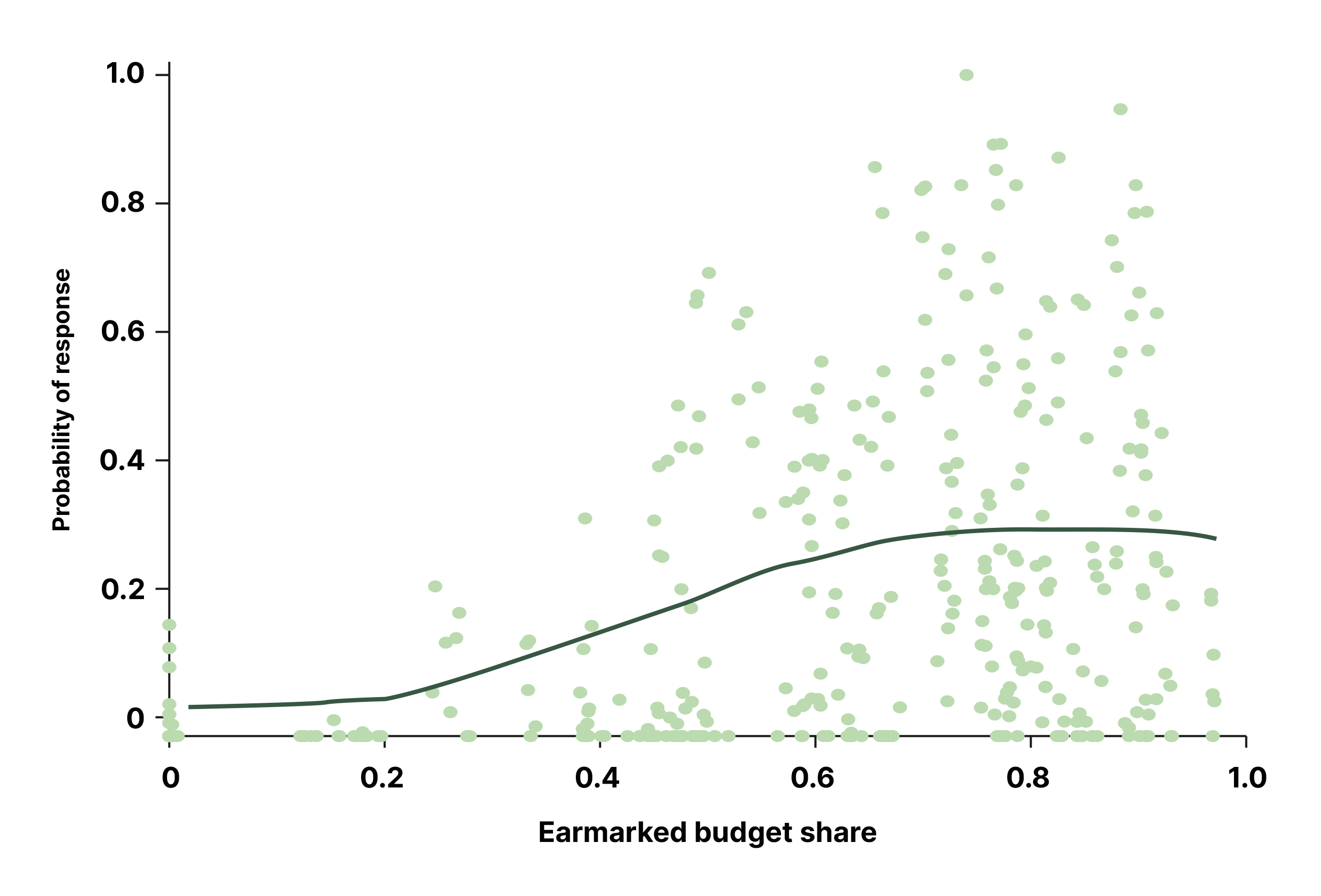
The empirical relationship between earmarked funding and humanitarian performance is not linear. Instead, it follows a distinct inverted U-shape curve: whereas a moderate amount of earmarking acts as an operational stimulant, excessive reliance on it severely cripples capacity. It is in this latter zone of hyper-earmarking when good funding turns bad.15
Figure 1 charts this relationship against an HIO’s probability of responding to a disaster at all. Focusing first on lower earmarked budget shares, incremental increases in ear-marking boost the probability of response. This environment keeps HIOs hyper-alert and agile, driving them to build robust fundraising operations. OCHA, UNFPA, and WHO are among the HIOs operating within this middle tier, where earmarked shares hover around 50%. Once an agency’s budget crosses the threshold of 80% earmarked resources, however, the effect reverses. Overburdened by rigid donor constraints, administrative overheads and hyper-specific project mandates, operational flexibility vanishes. Several organisations sit on this perilous downward slope, including the Food and Agriculture Organization of the United Nations (FAO), the International Organization for Migration (IOM), the United Nations Human Settlements Programme (UN-Habitat), UNHCR and WFP.
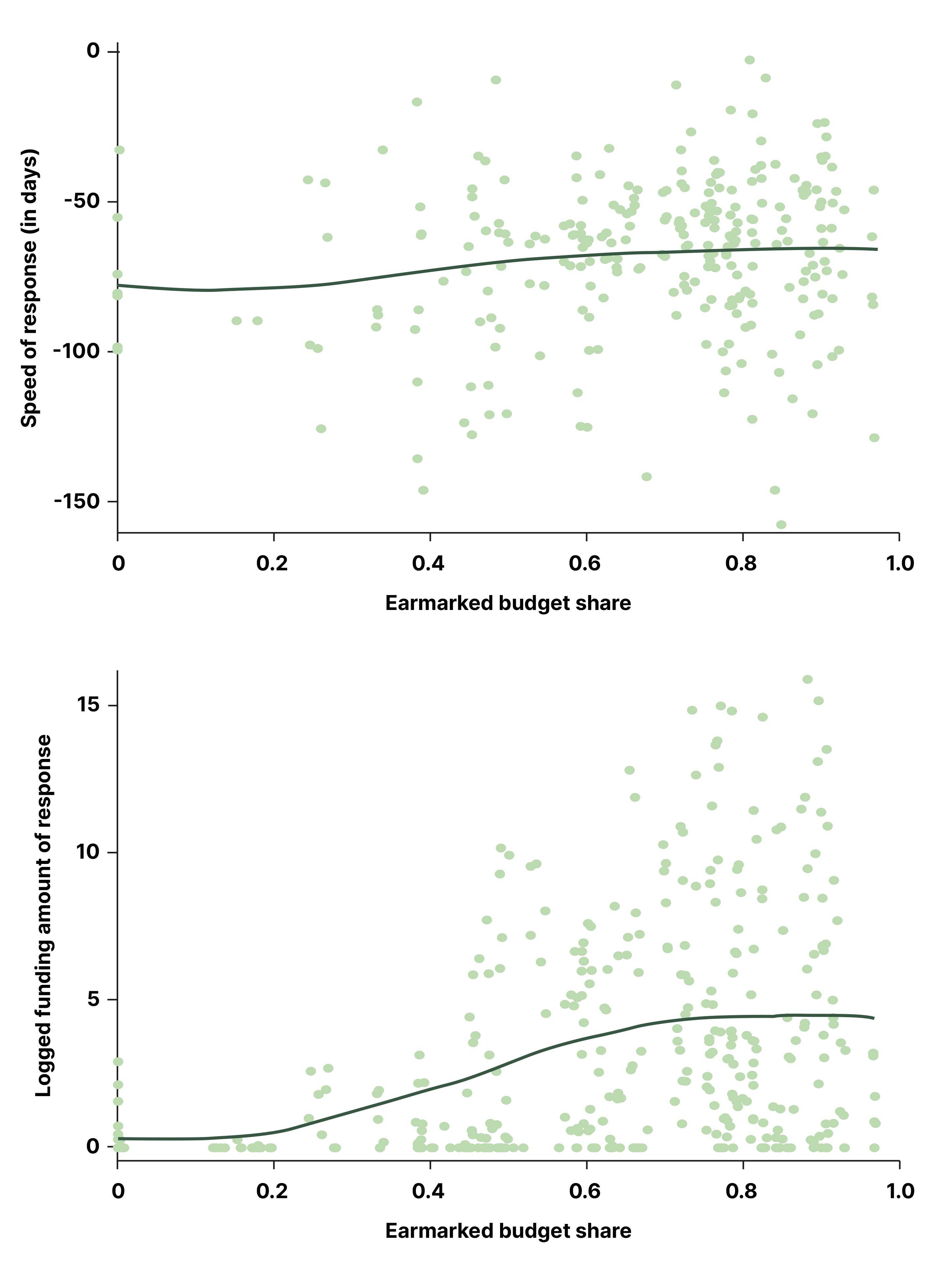
Figure 2 isolates response speed (top) and overall financial mobilisation (bottom) in order to capture how this structural reality bleeds into other operational metrics. As can be seen, the speed of response follows a similar curve but merely plateaus at extreme earmarking levels. Meanwhile, although earmarking initially aids financial mobilisation by driving HIOs to develop highly competitive fundraising operations, this advantage evaporates at the far end of the spectrum due to the administrative burden of managing a fragmented grant portfolio.
Earmarked Budget Share and Other Performance Dimensions
The Self-Defence Mechanism: Rapid Response Facilities
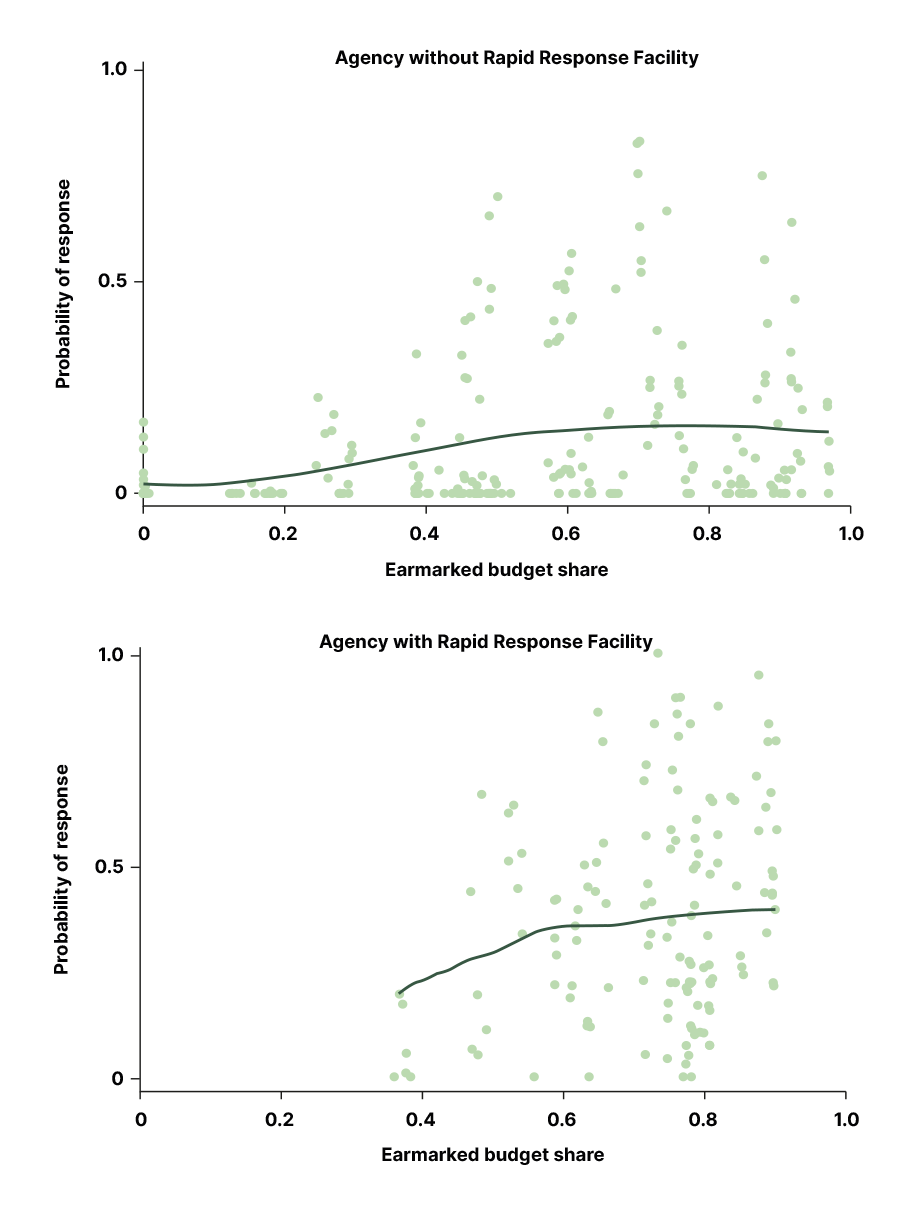
HIOs can insulate themselves from this volatile funding ecosystem by constructing internal firewalls known as Rapid Response Facilities (RRFs). A prime example is the WFP’s Immediate Response Account.16 Rather than wait weeks for donor pledges to clear in the wake of a sudden crisis, the WFP can simply tap the account to unlock millions of dollars within days. These funds can then be used to jump-start supply chains, buy food, and charter aircraft while external earmarked funding streams slowly mobilise.
We put this buffering theory to the test by collecting original data on RRFs, then splitting our sample into those HIOs with an active RRF versus those without. Figure 3 reveals a stark divergence: the destructive downward slope associated with excessive earmarking only occurs when agencies lack an RRF. In other words, HIOs equipped with a robust internal liquidity mechanism appear to largely absorb the operational shocks of incremental earmarking, maintaining high responsiveness even under severe budget restrictions.
Earmarked Funding and Responsiveness of HIOs With and Without Rapid Response Facilities
Behind the Earmarking Surge: Interorganisational Competition and Donor Leverage
Although donor preferences are typically blamed for the rise of restrictive earmarking, another powerful structural driver has had a growing impact behind the scenes: hyper-competition within an increasingly crowded humanitarian ecosystem.
This friction has been driven by an explosion of humanitarian actors operating with overlapping mandates. According to the OCHA Financial Tracking Service, the number of active global humanitarian organisations surged from 146 in 2014 to 220 by 2020.17 Furthermore, among UN HIOs, the median country-level emergency response in 2014-2020 involved 2.86 agencies – a net increase of 0.65 agencies per crisis compared to 2004-2010.
While the number of competing organisations has ballooned, the pool of sovereign financiers has stagnated. In the case of a typical UN HIO, the median number of unique donors stood at around 20 in 2020 – virtually unchanged from 19 in 2014. Worse, actual funding power has condensed into a shrinking oligopoly of capitals. Between 2014 and 2020, the probability of any two contributions coming from the same donor rose from 23% to 28% – a massive 22% jump.18 This concentration means a handful of Western donors now have outsized leverage.
Naturally, systemic competition and tight earmarking reinforce one another, becoming a vicious cycle. Fleeting financial stability means HIOs are perpetually anxious about maintaining institutional relevance and keeping their operations funded. To survive, they must aggressively chase any available cash, frequently expanding their remits beyond core capabilities into thematic sectors already served by other organisations.
Rather than eliminating competition, the UN’s Cluster Leadership Approach – introduced in 2005 to coordinate cross-agency responses – has merely shifted the battle-field.19 Instead of fighting over small ad hoc projects on the ground, HIOs now conduct intense upstream lobbying campaigns aimed at ensuring their designated sectoral clusters are officially ‘activated’ during an emergency. In doing so, they are able to secure their slice of the earmarked pie before relief operations even begin.
Conclusion: Navigating the Humanitarian Tipping Point
If the international aid architecture is to adequately protect vulnerable populations in an era of escalating crises, then structural corrections along the following three strategic frontlines should be pursued.
Calibrate the Funding Mix: Donors and HIO leadership must explicitly acknowledge the empirical tipping point that governs earmarked funding. Given the relationship follows an inverted U-shape, the goal should not be the total elimination of earmarked tracks – on the contrary, moderate earmarking injects a healthy baseline of accountability. Nevertheless, HIOs need to actively monitor their portfolio balances, ensuring their earmarked resource share does not reach the level where structural paralysis sets in.
Capitalise Rapid Response Facilities: High-quality core funding is an operational prerequisite, not a luxury. Donors should, therefore, capitalise RRFs: by allowing agencies to deploy capital within hours of a sudden-onset crisis, these facilities neutralise the inefficiencies born from systemic competition and earmarked funding constraints.
Move Beyond Mergers: While merging agencies with overlapping mandates – an objective currently being pursued as part of the UN80 reform – may appear a logical step towards reducing wasteful competition, it is largely a superficial fix that dodges the real issue.20 Mergers cannot substitute for a fundamentally healthy funding architecture. If the resulting consolidated agencies continue to be starved of core funds, then the underlying pathologies of hyper-earmarking will simply persist at a larger scale.
Footnotes
Humanitarian Action, ‘Mid-Year Review
of the Global Humanitarian Overview: Delivering for People in Crisis Against the Odds’, 12 June 2026, https://humanitarianaction.info/#:~:text=In%20June%202026%2C%20humanita….
Bruno Abarca, ‘Humanitarian funding: Sources, mechanisms and the 2025 crisis’, Salud Everywhere, 5 July 2026, https://saludeverywhere.com/en/humanitarian-aid-and-international-devel….
OECD, Multilateral Development Finance 2026 (Paris: OECD Publishing, 2026), https://doi.org/10.1787/0720370a-en.
Office of the Spokesperson, ‘United States Pledges Additional $1.8 Billion in Life-Saving Humanitarian Funding to OCHA’s Humanitarian Reset & Shares Powerful Results from the Trump Administration’s UN Humanitarian Reform Agreement’, 18 May 2026, https://www.state.gov/releases/office-of-the-spokesperson/2026/05/unite….
OECD, ‘Earmarked Funding to Multilateral Organisations: How is It Used and What Constitutes Good Practice?’, October 2020, www.oecd.org/en/publications/earmarked-funding-to-multilateral-organisa….
ICAI, ‘The UK’s Approach to Funding the UN Humanitarian System’, 18 December 2018, https://icai.independent.gov.uk/html-version/humanitarian-reform/#:~:te….
Good Humanitarian Donorship, ‘Multi-year funding modalities: Relevant GHD principle 13’, www.ghdinitiative.org/ghd/gns/best-practices.html#:~:text=The%20provisi…; ‘The Grand Bargain: A Shared Commitment to Better Serve People in Need’, 23 May 2016, https://interagencystandingcommittee.org/sites/default/files/migrated/2….
CERF, ‘Who we are’, https://cerf.un.org/about-us/who-we-are.
B. Reinsberg and M. Heinzel, ‘Siloes of influence: The political economy of resourcing international organizations’, The Review of International Organizations (2026), https://doi.org/10.1007/s11558-026-09615-9.
Andreas Fuchs and Samuel Siewers, ‘The Speed of Aid: Strategic Urgency in International Emergency Relief’, KIEL Working Paper No. 2290, June 2025, www.kielinstitut.de/fileadmin/Dateiverwaltung/IfW-Publications/fis-impo….
M. Baumann and B. Reinsberg, ‘Pathologies in the United Nations development system: The role of funding structures’, Global Governance: A Review of Multilateralism and International Organizations 31/4 (2025), pp. 395–427, https://doi.org/10.1163/19426720-03104002; M. Heinzel, B. Cormier and B. Reinsberg, ‘Earmarked funding and the control–performance trade-off in international development organizations’, International Organization 77/2 (2023), pp. 475–495, https://doi.org/10.1017/S002081832-3000085; B. Reinsberg and J. Taggart, ‘How does earmarked foreign aid affect recipient-country ownership?’, Journal of International Development 37/3 (2025), pp. 773–788, https://doi.org/10.1002/jid.3985.
The EM-DAT database can be found at: www.emdat.be/.
UN CEB, ‘Financial statistics’, https://unsceb. org/financial-statistics; B. Reinsberg, M. Heinzel and C. Siauwijaya, ‘Tracking earmarked funding to international organizations: Introducing the earmarked funding dataset’, The Review of International Organizations (2024), https://doi.org/10.1007/s11558-024-09548-1.
WFP, ‘What is the Immediate Response Account?’, www.wfp.org/immediate-response-account.
Data accessible at https://fts.unocha.org/ (author calculations available on request).
Data accessible at https://fts.unocha.org/
UNHCR, ‘Cluster approach’, https://emergency.unhcr.org/coordination-and-communication/cluster-syst….
C. Lennon, ‘UN80 Initiative: “Critical new phase” for UN reform effort’, UN News, 28 May 2026, https://news.un.org/en/story/2026/05/1167593.