Dr Niels Keijzer is a senior researcher at the German Institute of Development and Sustainability (IDOS) in Bonn, where – as part of the institute’s research programme on Inter- and Transnational Cooperation – he coordinates a project on the European Union’s development and foreign policy. Niels also represents IDOS in the European Think Tanks Group (ETTG) and in the European Research Alliance for Sustainable Development (ERASuD).
Dr Ronny Patz is a United Nations expert at IDOS. His research focuses on the financing of the UN system and its many agencies. Ronny co-authored Managing Money and Discord in the UN: Budgeting and Bureaucracy (Oxford University Press, 2019, with Klaus H. Goetz) and has published various studies on UN, OSCE and EU financing. He comments regularly on LinkedIn on UN reform and budgetary developments.
Introduction
For many years, the United States’ dominant role in funding the United Nations system has overshadowed the emergence of another major donor: the European Union. In 2024, the EU was a larger contributor to the UN system than 26 of its 27 member states; only Germany contributed more.1
In some UN agencies and entities, EU budget contributions constitute – or, in certain years, have constituted – the largest or second-largest source of financial support.2 EU funding has thus become an important pillar of the UN system’s operational work and provides a basis for the EU to engage as an actor in its own right in UN governance structures. Consequently, negotiations over the EU’s next longterm budget for 2028–34 will help shape both future EU funding to the UN system and the EU’s broader support for global multilateralism.
Three central questions guide this contribution:
- Which parts of the UN system are most dependent on EU support, and what drives the EU’s interest in financing particular agencies?
- To what extent does EU funding to the UN system align with and complement contributions from its 27 member states?
- As EU member states and the European Parliament negotiate the 2028–34 Multiannual Financial Framework (MFF) on the basis of the European Commission’s proposal, what might the future of EU funding to the UN system look like in the 2030s?
A central prediction of this article is that the EU is likely to remain a major funder of the UN system; however, the scale, nature, and scope of that funding remain uncertain.
Fiscal pressures within the EU and its member states are particularly evident in development cooperation and humanitarian aid. Against this backdrop of economic and geopolitical pressure, the EU may increasingly favour its own security and geoeconomic interests, directing its predominantly tightly earmarked UN funding towards these priorities rather than towards strategic investment in global multilateralism, despite political statements to the contrary.3
One way a stronger emphasis on EU interests may manifest itself is through strategic procurement or ‘Buy European’ requirements that could result in a greater proportion of EUfunded activities being (co)implemented by European actors.4 Meeting such requirements may prove difficult or even legally impossible for some UN agencies.5 At the same time, there are indications that the EU wants to strengthen its ‘Team Europe’ approach, with multilateral aid decisions by the EU and its member states more closely aligned and coordinated to maximise the effectiveness and efficiency of their collective support to the UN system. In practice, this could mean directing more funding from the EU and its member states towards areas considered shared European priorities. Alternatively, the EU could reduce funding for areas of UN work where member states are expected to contribute more – or vice versa – thereby seeking greater complementarity within the Team Europe approach.6
EU Funding to the UN System: Taking Stock of a Complex Picture
Data published by the UN System Chief Executives Board (UNSCEB) show that, in 2024, the EU provided US$ 3.6 billion of the US$ 67.1 billion in revenue received by the UN system, equivalent to 5% of the total (excluding the Pan American Health Organization, or PAHO).7 Of the EU’s funding to the UN development system – which covers humanitarian and development activities – 91.3% took the form of tightly earmarked projectlevel funding, compared with 5.9% in lightly earmarked pooled funding mechanisms and 2.8% in flexible funding.
The 2.8% provided as flexible funding is almost entirely accounted for by the EU’s core support to the United Nations Relief and Works Agency for Palestine Refugees in the Near East (UNRWA), which received US$ 94 million in voluntary core funding from the EU in 2024.8 This funding stems from a multi-year European Commission decision, adopted in 2022, on core support to UNRWA.9 EU support to UNRWA has been continuous since the 1970s. Initially, this consisted largely of inkind food aid; following a proposal by the European Commission in 1982, the EU shifted towards supporting UNRWA’s budget.10 On a much smaller scale, the EU has also committed to providing longterm unearmarked funding for the UN’s human rights work through the Office of the High Commissioner for Human Rights (OHCHR), with € 5.3 million (around US$ 6 million) announced for 2025.11
Unlike its 27 member states, the EU itself is not a UN Member State and therefore does not pay assessed contributions. However, as a member organisation of the Food and Agriculture Organization of the United Nations (FAO), the EU does pay an administrative fee alongside the assessed contributions of its member states.12 From a UN system perspective, the limited EU support for core UN entities financed through assessed contributions – notably the work of the UN Secretariat and UN Peacekeeping – is thus unsurprising. At the same time, this highlights the extent to which EU funding is concentrated on operational UN activities and on EU policy priorities rather than on the UN system’s broader ‘backbone structures’: the intergovernmental, operational and logistical, policy and normative, and country and regionallevel functions that enable the system as a whole to operate, independent of funding sources or which UN entity provides those functions.
(A) EU share of total UN entity revenue (UNSCEB data, own calculation) (B) EU funding to top-15 UN entities — 2020–2024 ($ millions)
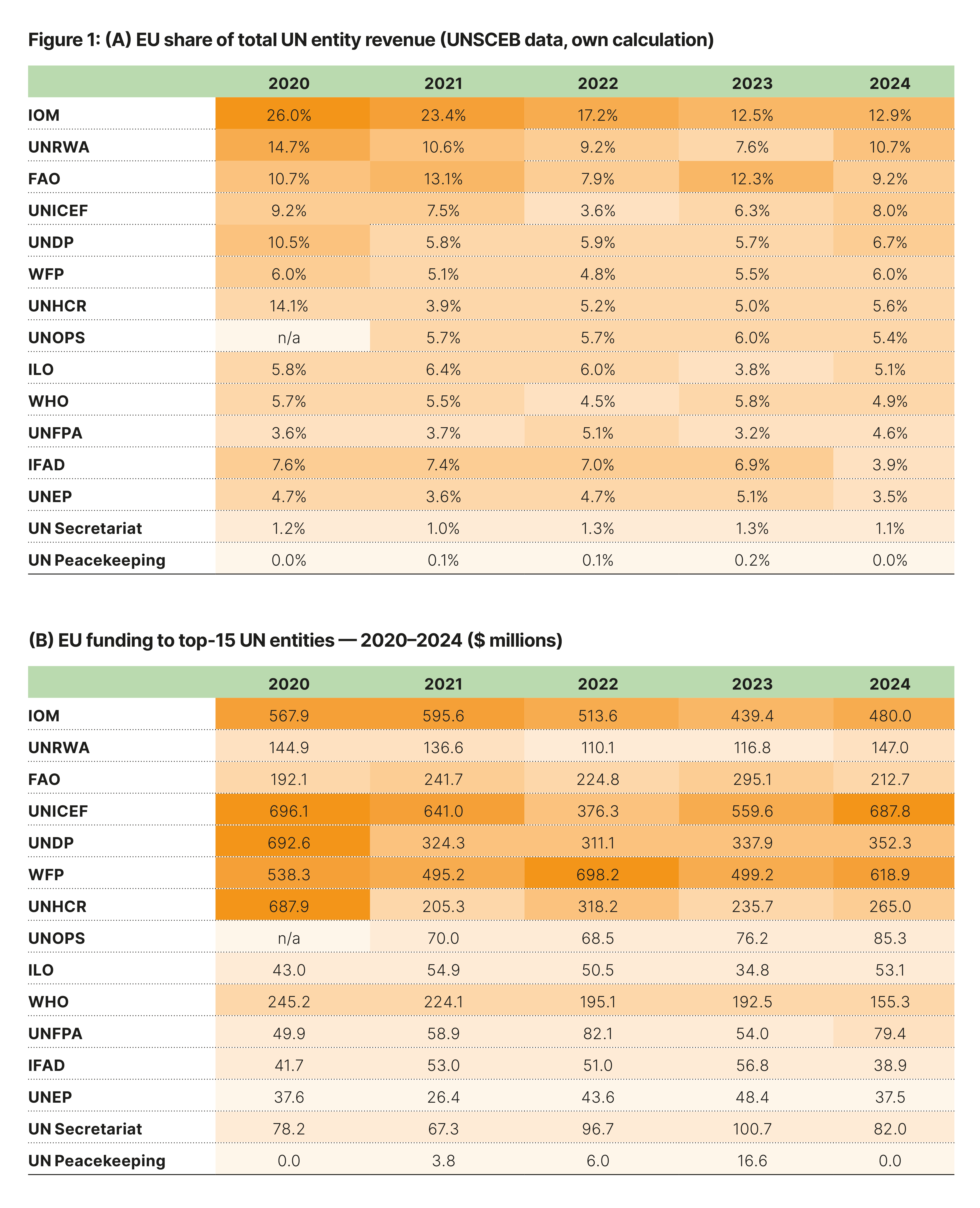
Looking at EU funding received by individual UN entities, the United Nations Children’s Fund (UNICEF) and the World Food Programme (WFP) received the largest absolute amounts in 2024, accounting for 18% and 16%, respectively, of total EU contributions. They were followed by the International Organization for Migration (IOM), the United Nations Development Programme (UNDP) and the UN Refugee Agency (UNHCR).13 Despite receiving the largest absolute amounts of EU funding, UNICEF and WFP – which are also among the largest UN system entities in financial terms – are proportionately less reliant on EU funding than entities such as IOM and UNRWA. In 2024, the EU accounted for 12.9% of IOM’s total revenue and 10.7% of UNRWA’s (see Figures 1A and 1B).
Data from the EU’s Financial Transparency System show that individual UN entities receive different mixes of funding from European Commission departments (DirectoratesGeneral, or DGs), reflecting the particular EU policy areas through which their activities are financed. During 2020–24, UNICEF received EU funding through both the Commission’s development arm (DG DEVCO, subsequently DG INTPA) and its humanitarian arm (DG ECHO), while WFP’s EU funding came almost entirely through DG ECHO. UNDP received mainly development funding, supplemented by funding through the then-DG NEAR for the EU’s Neighbourhood and Enlargement policies,14 including work involving countries in the Eastern Neighbourhood on a path towards EU membership. IOM received relatively similar shares of funding from DG INTPA, DG ECHO and DG NEAR, as well as from DG HOME, the Commission department responsible for migration and home affairs. EU financing for UNRWA came almost exclusively through DG NEAR’s Southern Neighbourhood funding.15
Overall, EU funding is geared towards certain UN entities, several of which depend heavily on EU support for their operational activities. Changes over time in both absolute and relative funding levels reflect not only shifting EU policies, but also changes in the scale of UN operations – for instance, the scaling down of healthrelated activities as COVID-19 related operations declined or, conversely, the increase in food aid in 2022 following foodprice hikes after Russia’s full-scale invasion of Ukraine.16
Team Europe: On the Alignment of EU and EU Member State UN Funding
The differentiated funding mixes outlined above indicate how strongly EU funding to the UN system is shaped by specific EU policy goals. In practice, this means that the EU predominantly engages the UN system as an implementing partner, drawing on its global and regional capabilities to deliver food aid, promote good governance, and address refugee and migration issues, among other priorities – including in response to Russia’s full-scale invasion of Ukraine. Although the EU can provide support to the UN system on a scale that many of its smaller member states cannot match, its funding decisions are shaped by distinct EUlevel policy priorities, differentiating it from individual country donors.
During and following the COVID-19 pandemic, the EU and its member states made considerable progress in working together as ‘Team Europe’. While driven in part by concerns over low collective visibility and perceived competition with other cooperation partners, including China, this cooperative approach has been maintained in the years since. It therefore continues to offer a means of strengthening the collective effectiveness of international cooperation by the EU and its member states.17 Particularly important in this regard are the Team Europe Initiatives (TEIs): packages of EU and memberstate actions in a given country or sector that enable varying degrees of cooperation. TEIs have also played a key role in advancing the EU’s Global Gateway initiative, which promotes broadly defined infrastructure investment worldwide.
Council conclusions on Team Europe, adopted at ministerial level in November 2023, set out a number of future ambitions and objectives, including the ‘organisation of highlevel policy dialogues, Team Europe missions, political engagements and participation in high-level and investment events in partner countries and multilateral fora’.18 To date, however, joint engagement by the EU and its member states with UN agencies remains a work in progress. A May 2026 EU proposal on humanitarian action identifies potential for greater cooperation in this area, with some member states calling for an action plan setting out how this could be achieved.19
The EU’s New Multi-Annual Budget: On the Path to a Smaller Footprint?
The European Commission’s July 2025 package of proposals for the 2028–34 MFF has prompted debate in Brussels and EU national capitals about the future of EU funding for both internal and external policies. These negotiations concern not only the overall size and allocation of the EU budget, but also the legal, policy and implementation frameworks that will guide spending decisions throughout the 2028–34 period. As indicated above, key drivers of EU funding to the UN system include support for UN operational activities; the use of UN system capacities in the EU’s Eastern and Southern Neighbourhoods; and the management of migration-related issues through UN structures from both humanitarian and EU internal-policy perspectives.
The question, then, is whether the EU will continue to see the UN as a key strategic partner for advancing its policy goals, or instead place greater emphasis on European or local actors as implementing partners. Current debates around strategic procurement and ‘Buy European’ rhetoric point towards the latter possibility. A related question is whether the EU might shift at least some of its projectlevel earmarked support towards UN backbone functions or, conversely, whether the Team Europe approach will lead to even greater projectisation of UN funding.
The key regulatory decision shaping the majority of future EU funding to the UN system will be the provisions of the proposed Global Europe Instrument regulation, for which the Commission proposed a total funding envelope of € 200.3 billion in July 2025.20 These provisions are being negotiated alongside the overall size of the MFF and its specific headings, including external action, of which Global Europe is the largest component. Five elements of these negotiations are particularly relevant to the UN system:
First, decisions incorporated into the forthcoming MFF will shape the EU’s annual budgets throughout the 2028–34 period. Decisions on overall funding levels, as well as on the degree of flexibility and the ringfencing of particular policy areas, will therefore influence EU spending well into the 2030s.
Second, the draft Global Europe Instrument has a strong geographic focus on the EU’s neighbourhood. UN entities seeking EU funding may therefore need to take greater account of these geographic priorities in their operational activities.
Third, the EU’s Global Gateway initiative – its geopolitical investment strategy – is expected to feature prominently in the future budget. Together with the current policy emphasis on privatesector mobilisation, this suggests that European actors may increasingly be prioritised in the implementation of EU foreign-policy objectives. This could favour European companies and associated supply chains, potentially reducing the funding available to UN actors.21 Greater earmarking could also constrain UN entities’ operational independence and their ability to pursue their multilateral mandates.
Fourth, it remains unclear to what extent the Global Europe Instrument will support UN mandated frameworks such as the Sustainable Development Goals and their future successor framework; maintain the share of official development assistance (ODA) in external spending; or reinforce global policy commitments that are currently under pressure, including those relating to gender equality and climate change. At present, the balance between cooperation focused on short-term economic ‘mutual interests’ and cooperation centred on the equitable and sustainable provision of global public goods – which are also of mutual interest, albeit over the longer term – appears to be shifting towards the former.
Fifth, with global multilateralism under pressure, the UN system facing the deepest financial crisis in decades,22 and largescale reform processes including UN80 and the Humanitarian Reset under way at the same time,23 it remains to be seen whether – and to what extent – EU funding will be deployed strategically to sustain the UN system’s backbone structures as central elements of global multilateralism. Such an approach would require a shift towards less tightly earmarked and more corelike funding. This, in turn, would require both a clear EU level policy decision to pursue such objectives and, where necessary, adjustments to the EU’s current financial rules and practices, enabling a more strategic and less projectised approach to supporting the UN system’s global functions.
Conclusions: Catalyst and Cataclysm for Global Multilateralism
At the time of writing (mid2026), there appears to be little prospect of a strategic shift in EU funding towards the backbone structures of global multilateralism. On the contrary, should the Global Europe Instrument be adopted broadly in the form proposed in July 2025, EU funding to the UN system is likely to decline, even if overall EU external spending remains stable or increases. At the same time, voices within the European institutions are questioning the UN’s role as an implementing partner, raising a broader question about whether – and how – future EU funding might instead strengthen the UN system’s key functions.24
Nevertheless, the EU’s contributions to the UN system over the past decade have been substantial. As demonstrated above, however, this funding remains heavily projectised and tightly earmarked, and is closely linked to global and regional crisis management, the governance of migration and refugee flows, and the EU’s Enlargement and Neighbourhood policies. EU funding to the UN system therefore already reflects significant European policy interests. A further shift towards the EU’s own geostrategic priorities could place additional pressure on funding for the UN system and its multilateral mandates.
The broader question is whether the EU sees itself as a global humanitarian and development actor operating within – and supporting – a genuinely multilateral system, or increasingly as a geopolitical actor that uses the UN system principally where doing so advances its own economic and security interests. Negotiations over the forthcoming MFF may not provide an immediate answer. But these decisions covering the 2028–34 period will have longterm consequences for the UN system, its functions and the ways in which it is funded.
Endnotes
See UNSCEB data for 2024 on “Revenue by government donor” (https://unsceb.org/statistics/revenue-by-government-donor) and “Revenue by non-government donor” (https://unsceb.org/statistics/revenue-bynon-government-donor).
For example, in UNICEF, the EU was the second largest donor in 2025, behind the USA, see UNICEF Annual Report 2025, p.56, available at: https://www.unicef.org/media/181711/file/UNICEF%20Annual%20Report%20202…; in IOM the EU was the top donor, ahead of the USA in 2025, see IOM Audited Financial Statements 2025, p.7, available at: https://governingbodies.iom.int/system/files/en/council/117/c-117-3-fin….
CONCORD, ‘The EU Sails Away from International Cooperation with the Biggest Aid Cuts in a Decade’, 9 April 2026, https://concordeurope.org/2026/04/09/the-eu-sailsaway-from-internationa….
S. Koch and N. Keijzer, ‘Shifting ideology or shifty tautology? The EU’s policy on international partnerships in turbulent geopolitical times.’ In: Furness, M. and Keijzer, N. International Development Cooperation and the Emerging Global Order, IDOS Discussion Paper 4/2026, pp. 8–11, https://www.idos-research.de/fileadmin/user_upload/pdfs/publikationen/d….
S. Koch, N. Keijzer and I. Friesen‚ ‘COVID-19 as a critical juncture for EU development policy? Assessing the introduction and evolution of “Team Europe”’, Journal of European Integration 46/4 (2024), pp. 411–31, https://doi.org/10.1080/07036337.2023.2299928.
Data source: United Nations Economic and Social Council (ECOSOC), ‘2024 United Nations Development System funding data’, provided as annex to the 2026 Secretary-General’s report on the implementation of the QCPR, https://ecosoc.un.org/sites/default/files/2026-05/SGR26-Funding%20Annex… (see Tab ‘Contributions by Entity & Donor’, line ‘Other - European Commission’).
European Commission, ‘Commission implementing decision of 9.8.2022 on the financing of the individual measure in favour of Palestine refugees for 2022-2024’, C(2022) 5632 final, https://enlargement.ec.europa.eu/commissionimplementing-decision-982022….
Commission of the European Communities, ‘Commission communication to the Council on aid from the European Community to UNRWA’, COM(82)227, 1982; Patz, R. and Thorvaldsdottir, S. ‘Drivers of EU budget contributions to UN refugee and migration agencies from the 1970s until today’, Unpublished Manuscript (5 Nov 2019) presented at the workshop ‘Evaluating the EU budget: a critical assessment’, University of Salento, 7-8 Nov 2019.
European External Action Service (EEAS), ‘EU statement at the launch of the Human Rights Appeal 2025’, 30 January 2025, www.eeas.europa.eu/delegations/un-geneva/eu-statement-launch-humanright….
EEAS, ‘The European Union and the Food and Agriculture Organization (FAO) – Relations with the EU’, 10 February 2026, www.eeas.europa.eu/un-rome/europeanunion-and-food-and-agricultureorgani….
For a detailed analysis see: Ronny Patz and Niels Keijzer, ‘The 2028–34 Multi-Annual Financial Framework: Three Scenarios on the Potential Future of EU Financing for Global Multilateralism’, ETTG Policy Brief 2, June 2026, https://ettg.eu/wp-content/uploads/2026/07/260701_ETTG-Brief-2_2026-1.p….
S. Koch, N. Keijzer and I. Friesen‚ ‘COVID-19 as a critical juncture for EU development policy? Assessing the introduction and evolution of “Team Europe”’, Journal of European Integration 46/4 (2024), pp. 411–31, https://doi.org/10.1080/07036337.2023.2299928.
Council of the European Union, ‘Team Europe approach – Council conclusions’, 21 November 2023, https://data.consilium.europa.eu/doc/document/ST-15684-2023-INIT/en/pdf.
European Commission and High Representative of the Union for Foreign Affairs and Security Policy, ‘Defending values, driving reform, delivering impact: The EU’s humanitarian action in a shifting global order’, JOIN(2026) 25 final, 27 May 2026, https://ec.europa.eu/echo/files/downloads/joint_communication_on_humani….
European Parliament, ‘2028-2034 MFF: Regulation Establishing Global Europe’, 2025, www.europarl.europa.eu/RegData/etudes/BRIE/2025/774702/EPRS_BRI(2025)77….
T. Camelli and R. Patz, ‘How to End the United Nations’ Current Financial Crisis… and Prevent Future Ones’, Center on International Cooperation, New York University, March 2026, https://cic.nyu.edu/wp-content/uploads/2026/03/Howto-End-the-United-Nat….
R. Patz, ‘The UN80 initiative as a productive failure: Between geopolitical disruptions and organizational path dependency’, GGI Analysis 1/2026, Global Governance Institute, https://doi.org/10.5281/zenodo.19351856.