The German Institute for Development Evaluation (DEval) provides governmental and non-governmental development cooperation organisations with independent and scientifically sound evaluations, which they can feed into their strategies, instruments, and programmes. By enabling evidence-based policymaking, DEval aims to make German development cooperation more effective and increase transparency in the use of public funds. DEval was established in 2012 and is mandated by the German Federal Ministry for Economic Cooperation and Development (BMZ).
Judith Ihl is a political scientist who works as an evaluator at DEval. She has contributed to evaluations of bilateral and multilateral development cooperation, as well as thematic evaluations focused on sustainable supply chains.
Dr Angela Heucher is a senior evaluator and team leader. At DEval, she has contributed
to evaluations of multilateral development cooperation, gender equality in post-conflict contexts, human rights, and sustainable supply chains. She holds a PhD in political science.
The Expert Group for Aid Studies (EBA) is a Swedish government committee mandated to evaluate and analyse the direction, governance, and implementation of Sweden’s official develop- ment assistance, with a specific focus on results and effectiveness. EBA aims to contribute to the efficient implementation of well-designed aid, focusing primarily on overarching issues within Swedish development assistance rather than individual projects. EBA was established in 2013 and consists of an Expert Group of ten members and a Stockholm-based secretariat.
Ravneet Singh is an assistant programme manager at EBA, with a background in development studies and economics. She manages evaluation projects focused on improving the effectiveness of Swedish development aid and has contributed to studies on Sweden’s new aid policy and aid funding modalities.
Dr Helena Hede Skagerlind is a programme manager at EBA. In her role, she contributes to evaluations of Swedish aid as a commissioner, project manager, and author in areas such as gender equality, human rights, multilateral aid, and anti-corruption. She holds a PhD in political science.
What Different Funding Modalities Enable
The recent drop in foreign aid, coupled with reduced multi-lateral core funding and increased earmarked contributions (see Figure 1), is placing substantial strain on the multilateral system as a whole and the UN system in particular.1 Funding to the UN system had increased steadily for many years, reaching a high of US$ 74.3 billion in 2022. By 2024, this figure had fallen to US$ 68.3 billion, with further reductions anticipated (see Figure 1, p. 37). Also relevant here is the exceptionally high degree of earmarking within the UN development system (UNDS): in 2024, 82% of UNDS funding was earmarked (see Figure 13, p. 57), compared with 45% of official development assistance overall (see Figure 1).
DAC countries’ core and earmarked ODA allocations
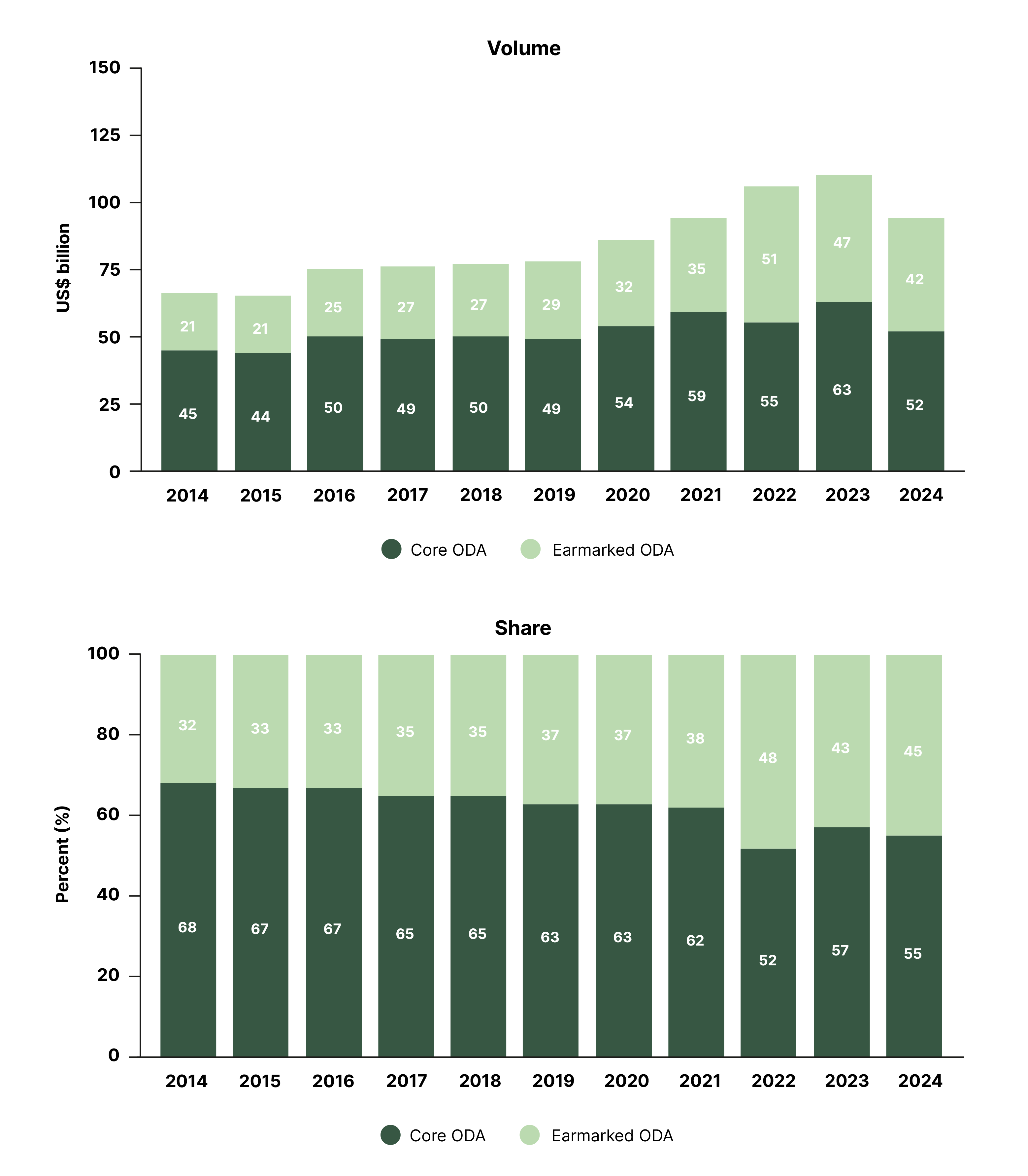
Source: OECD2
Note: Figures in the left graph equate to official development assistance (ODA) in US$ billion (calculations based on disbursements in 2023 constant prices); figures in the right graph equate to percentage share.
These growing resource constraints are intertwined with broader concerns around the effectiveness and legitimacy of the multilateral and UN systems. Against this backdrop, understanding how funding is allocated and what different financing modalities enable is critical. Such knowledge can help maximise development impact, ensure the effective use of scarce resources, and inform funding decisions amid heightened financial pressure.
Despite multilateral financing’s renewed prominence in policy and academic debates, empirical evidence on the effectiveness of core and earmarked funding remains limited and fragmented. In order to fill this gap, we conducted a systematic assessment aimed at examining which type of financing is most effective when it comes to multilateral development cooperation.3
The Effectiveness of Funding Modalities
The choice of funding modality has a clear impact on a development project’s effectiveness. Crucially, World Bank development projects financed through trust funds have been shown to have a positive effect on economic growth. However, in comparison to core-funded projects, the effect is smaller.4 It is also evident that, compared to core funding, earmarked funding weakens the ability of multilateral organisations to fulfil their mandates in a cost-efficient manner.5 This is largely because earmarked funding entails higher supervision and transaction costs. Thus, to achieve outcomes comparable to those of core-funded projects, both donors and multilateral organisations often need to commit greater financial resources.6
Moving beyond the project level, what impact does earmarked funding have on organisational effectiveness? In this respect, high levels of earmarking tend to restrict flexibility – an effect consistently highlighted in the literature. By contrast, flexibility is widely identified as a key advantage of core funding, as it enables multilateral organisations to operate in line with their mandates and respond strategically to developments.7 More flexible forms of earmarking, such as soft earmarking, can offer some of these benefits.8 For instance, there is evidence that soft earmarking through trust funds such as Gavi has generated positive results in terms of cost and resource efficiency.9 According to the Malaria Consortium, however, the significant budget cuts recently suffered by Gavi pose a major risk when it comes to maintaining and improving vaccination rates, especially in low-income countries.10
These findings underscore that increased donor control through earmarking is associated with weaker project outcomes and greater system-wide fragmentation. Ear-marking tends to encourage project-based approaches among both donors and multilateral organisations. For organisations, this can undermine long-term planning, reduce flexibility, and limit their ability to respond to changing needs. Over time, the role of the organisation in question may shift towards being an implementing agent for donor priorities, thereby diluting its original mandate. Moreover, organisations with high levels of earmarked funding may need to use core funding to subsidise the administrative costs of earmarked projects.11 In such circumstances, funds intended to support core mandates are diverted to cover the additional, unfinanced administrative expenses associated with earmarked contributions.12 Taken together, rising levels of earmarking, combined with broader budget cuts, place avoidable strain on multilateral organisations.
In contrast to other multilateral organisations, the evidence relating specifically to the UN system is extensive and consistent: the UN system requires core or softly ear-marked funding to fulfil its mandate in accordance with its corporate functions.13 Core funding is particularly important, as it ensures necessary institutional capacity, facilitates coordination across UN organisations, and supports longer- term strategic planning.
Critical Gaps in the Evidence Base
Despite these insights, important knowledge gaps remain. For instance, it is vital that we understand the various ways in which earmarked funding affects the entire multilateral system. The large number of actors involved, combined with the contrasting financing modalities, means the system is highly diversified. Given this, a key question to consider is how earmarking affects the cost- and outcome-effectiveness of the broader multilateral system. While some insights useful to future financing decisions may be inferred from organisation-level studies, there is a clear need for more system-level analysis.
Furthermore, there is scant evidence directly comparing the effectiveness of core and earmarked funding or showing how best to combine the two modalities. Evidence is also lacking on how the effectiveness of different financing modalities varies across regions, countries and sectors. Further research is needed in all these areas.
What Policymakers Should Consider
By prioritising financial control and apparent short-term efficiency, donors risk overlooking not only the additional transaction costs incurred by earmarking but also its broader organisational and system-wide consequences. Sufficient levels of core and softly earmarked funding, as envisaged in the UN Funding Compact, are essential for maintaining the resilience, adaptability, and long-term effectiveness of the UN system.14 Tightly earmarked funding should therefore be used as selectively as possible, and only after careful consideration of its potential effects on organisational performance and development outcomes.
Donors should adopt a more strategic, evidence-informed approach to funding modalities. This includes being fully aware of what earmarking entails, providing flexibility where they can, and giving due consideration to the trade-offs involved with different financing arrangements. At the same time, recipient organisations need to improve transparency concerning the full administrative and operational costs associated with earmarked funding. More broadly, both UN organisations and donors would benefit from more structured dialogues on how funding modalities impact effectiveness, delivery of mandates and long-term development outcomes.
When it comes to ongoing reform discussions, particularly those surrounding UN80, attention needs to be paid to both the UN system’s overall effectiveness and the broader development objectives it seeks to advance. While the UN system fulfils crucial normative, convening and coordination functions, development more broadly is ultimately about strengthening institutions and systems, not just delivering individual projects. A narrow focus on the project level risks overlooking these important organisational and system-wide dimensions.
Amid growing geopolitical uncertainty and financial pres-sures, it is perhaps understandable that reform proposals emphasising cost efficiency and spending cuts feature prominently. However, the discussion should not end there. Policymakers engaged in UN80 reforms must also consider the role the UN system currently plays – and can continue to play – in addressing global development challenges. The ways in which different funding modalities affect UN system effectiveness constitute an important part of this broader discussion.
Endnotes
Organisation for Economic Co-operation and Development (OECD), ‘A historic decline in foreign aid: Preliminary 2025 ODA data’, 9 April 2026, www.oecd.org/en/data/insights/data-explainers/2026/04/a-historic-declin….
OECD, ‘Multilateral development finance’, OECD Data Explorer, Members’ total use ofthe multilateral system, 2026, www.oecd.org/en/topics/multilateral-developmentfinance.html.
J. Ihl et al., ‘The Effectiveness of Core and Earmarked Funding in Multilateral Development Cooperation – Systematic Review’, German Institute for Development Evaluation (DEval) and Expert Group forAid Studies, Sweden (EBA), 2025, www.deval.org/fileadmin/Redaktion/PDF/05-Publikationen/Berichte/2025_Mu….
M. Heinzel and B. Reinsberg, ‘Trust funds and the sub-national effectiveness of development aid: Evidence from the World Bank’, World Development 179 (2024), https://doi.org/10.1016/j.worlddev.2024.106609.
M. Heinzel, B. Cormier and B. Reinsberg, ‘Earmarked funding and the control–performance trade-off in international development organizations’, International Organization 77/2 (2023), pp. 475–495, https://doi.org/10.1017/S0020818323000085.
S. Migliorisi et al., Activity-Based Financial Flows in UN System: A Study of Selected UN Organisations: Volume 1 – Synthesis (Oslo: Norwegian Agency for Development Cooperation (Norad), 2012), www.norad.no/publikasjoner/2012/activity-based-financialflows-in-un-sys…; Multilateral Organisation Performance Assessment Network (MOPAN), MOPAN 2015–16 Assessments: International Labour Organization: Institutional Assessment Report (Paris: MOPAN, 2017), www.mopanonline.org/assessments/ilo2015-16/index.htm; L. K. Schmid, A. Reitzenstein and N. Hall, ‘Blessing or curse? The effectsof earmarked funding in UNICEF and UNDP’, Global Governance 27/3 (2021), pp. 433–459, https://doi.org/10.1163/19426720-
02703002.
C. M. Ljungman et al., Evaluation of Country Programme Support to UNFPA, UNICEF and UN Women. Final Report (Sundbyberg: Sida, 2022), https://cdn.sida.se/app/uploads/2022/11/17142835/EVA2022_4_62585en.pdf; MOPAN, MOPAN 2017–18 Assessments: Office of the United Nations High Commissioner for Refugees (UNHCR) (Paris: MOPAN, 2019), www.mopanonline.org/assessments/unhcr2017-18/UNHCR%20report%20[web-1a]…; MOPAN, MOPAN 2017–18 Assessments: World Health Organization (WHO) (Paris: MOPAN, 2019), www.mopanonline.org/assessments/who2017-18/index.htm; MOPAN, MOPAN Assessment Report: Office of the United Nations High Commissioner for Refugees (UNHCR) (Paris: MOPAN, 2024), www.mopanonline.org/assessments/unhcr/MOPAN_2024_UNHCR_Part1.pdf.
MOPAN, MOPAN 2015–16 Assessments: Gavi, the Vaccine Alliance. Institutional Assessment Report (Paris: MOPAN, 2017), www.mopanonline.org/assessments/gavi2015-16/Mopan%20GAVI%20[interactive….
Malaria Consortium, ‘Gavi replenishment marks a major step forward, but the shortfall threatens to undo critical progress’, 10 July 2025, www.malariaconsortium.org/news/gavi-replenishment-marks-a-major-stepfor….
G. Carrington et al., ‘A Space for Change: Partner Perspectives on an Effective Multilateral System’, Global Partnership for Effective Development Co-operation (GPEDC), 2022, www.effectivecooperation.org/SpaceForChange-FINAL-REPORT; MOPAN (note 9); MOPAN, MOPAN 2015–16 Assessments: United Nations Development Programme (UNDP). Institutional Assessment Report (Paris: MOPAN, 2017), www.mopanonline.org/assessments/undp2015-16/index.htm; MOPAN, 2015–16 Assessments: United Nations Human Settlements Programme (UN-Habitat). Institutional Assessment Report (MOPAN, 2017), www.mopanonline.org/assessments/unhabitat2015-16/index.htm; MOPAN, MOPAN 2017–18 Assessments: World Food Programme (WFP) (Paris: MOPAN, 2019), www.mopanonline.org/assessments/wfp2017-18/index.htm; MOPAN, MOPAN 2017–18 Assessments: World Health Organization (WHO) (Paris: MOPAN, 2019), www.mopanonline.org/assessments/who2017-18/index.htm; MOPAN, MOPAN 2019 Assessments: United Nations Industrial Development Organization (UNIDO) (Paris: MOPAN, 2020), www.mopanonline.org/assessments/unido2019/index.htm; MOPAN, MOPAN Assessment Report: United Nations Development Programme (UNDP). 2020 Assessment Cycle (Paris: MOPAN, 2021), www.mopanonline.org/assessments/undp2020/index.htm; MOPAN, MOPAN Assessment Report: United Nations Children’s Fund (UNICEF). 2020 Assessment Cycle (Paris: MOPAN, 2021), www.mopanonline.org/assessments/unicef2020/index.htm; MOPAN, MOPAN Assessment Report: Office of the United Nations High Commissioner for Refugees (UNHCR) (Paris: MOPAN, 2024), www.mopanonline.org/assessments/unhcr/MOPAN_2024_UNHCR_Part1.pdf; B. Reinsberg, ‘Earmarked funding and the performance of international organizations: Evidence from food and agricultural development agencies’, Global Studies Quarterly 3/4 (2023), https://doi.org/10.1093/isagsq/ksad056; Schmid, Reitzenstein and Hall (note 7).
See for example A. Heucher, J. Ihl and I. Reinstädtler, ‘The BMZ’s Multilateral Engagement: Financing and Interplay’, German Institute for Development Evaluation (DEval), 2025, https://www.deval.org/fileadmin/Redaktion/PDF/05-Publikationen/Berichte….